
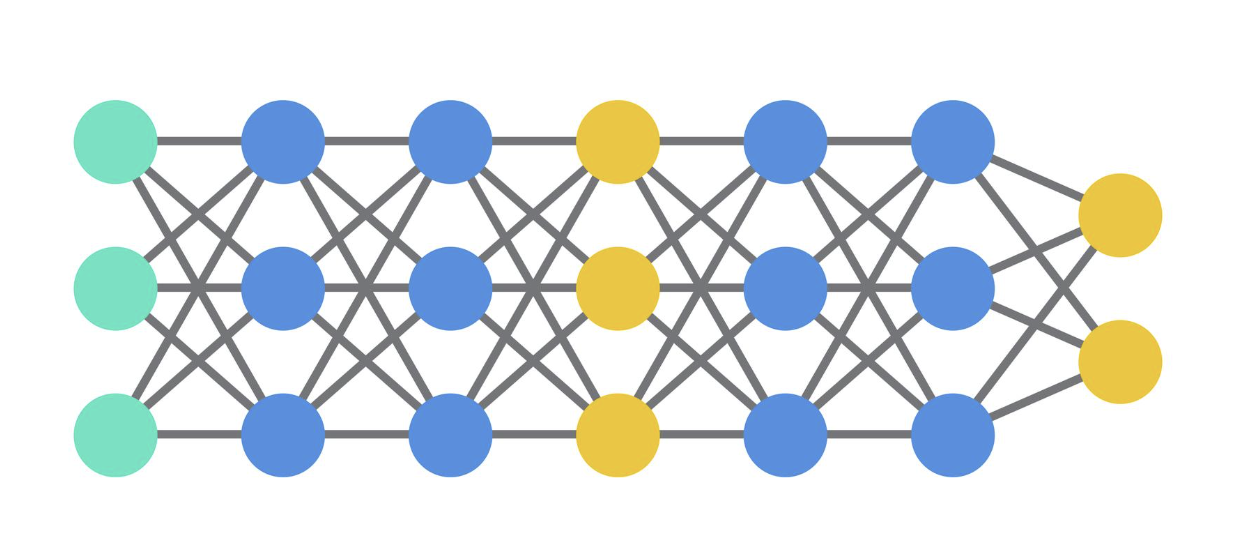
In Artificial Intelligence (AI), one of the most powerful models for working with images and videos is the Convolutional Neural Network (CNN).
CNNs help computers understand visual data — just like humans use eyes and brain to see and recognize objects.
CNNs are used in:
- Face unlock in mobiles
- Self-driving cars
- Medical scan analysis
- Security cameras
- Social media filters
What is a Convolutional Neural Network?
A Convolutional Neural Network (CNN) is a type of Deep Learning neural network designed to process image data (pixels).
An image is made of small dots called pixels.
Example:
- 256 × 256 image = 65,536 pixels
- Each pixel has color values (RGB)
CNN reads these pixel values and learns patterns like:
- Edges
- Corners
- Shapes
- Objects
So CNN = Model that “sees” images mathematically.
Why Do We Need CNNs?
Before CNNs, we used traditional Machine Learning.
Problem: We had to manually tell the computer what to detect.
Example — Detect Dog:
- Shape of ears
- Tail length
- Fur color
This was difficult and inaccurate.
CNN solved this by:
✅ Automatically finding features
✅ Learning directly from images
✅ Improving accuracy
So CNN removed manual work.
CNN Works
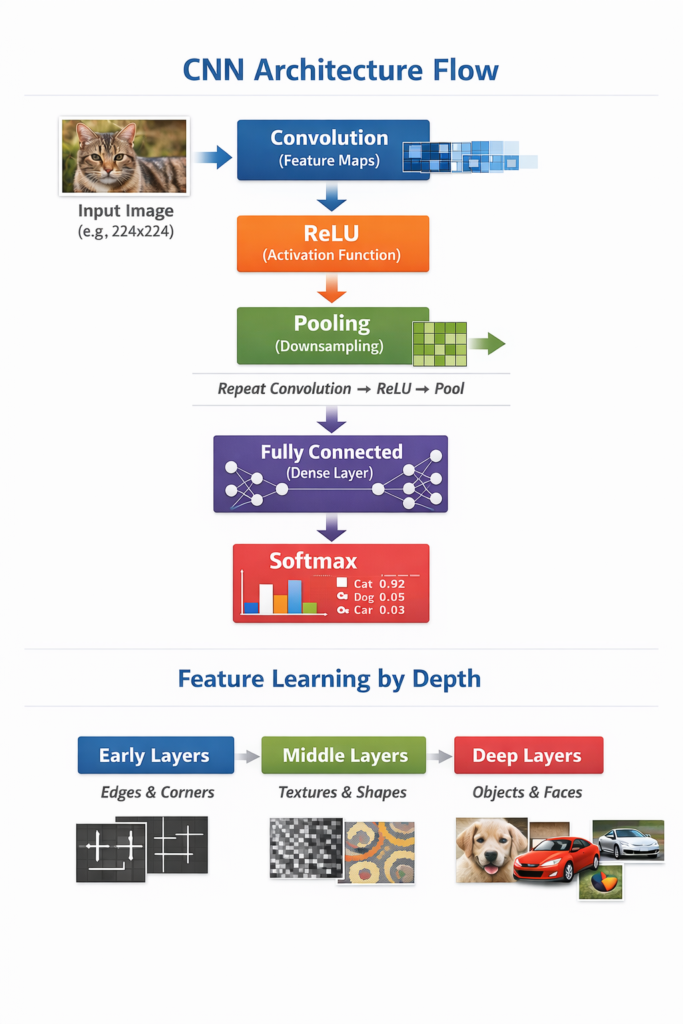
CNN processes images using layers.
1️⃣ Convolution Layer
This layer uses filters (kernels).
A filter is a small matrix like:
[ 1  0 -1
  1  0 -1
  1  0 -1 ]
It slides over the image to detect patterns.
Detects:
- Edges
- Lines
- Textures
Output → Feature Map
2️⃣ Activation Function (ReLU)
After convolution, we apply ReLU.
Formula:
f(x) = max(0, x)Purpose:
- Removes negative values
- Adds non-linearity
- Helps model learn complex patterns
3️⃣ Activation Function (ReLU)
Pooling reduces image size.
Types:
- Max Pooling → takes highest value
- Average Pooling → takes average
Example:
4×4 → becomes → 2×2
Benefits:
- Faster computation
- Less memory
- Prevents overfitting
4️⃣ Fully Connected Layer
Now features are flattened and sent to dense layers.
This layer:
- Combines all features
- Performs classification
Example Output:
- Cat
- Dog
- Car
5️⃣ Softmax Output Layer
Converts output into probabilities.
Example:
- Cat → 92%
- Dog → 5%
- Car → 3%
Highest probability = Final prediction.
CNN Flow
CNNs Used
1. Image Recognition
- Face detection
- Photo tagging
- Object detection
2. Medical Field
- Tumor detection
- X-ray analysis
- Brain scan diagnosis
3. Self-Driving Cars
- Lane detection
- Traffic signs
- Pedestrians
4. Security Systems
- CCTV monitoring
- Criminal detection
- Face recognition
5. Agriculture
- Plant disease detection
- Crop monitoring
6. E-Commerce
- Visual search
- Product recognition
Advantages of CNN
- Automatic feature extraction
- High accuracy
- Less preprocessing
- Works well on images
- Parameter sharing reduces cost
Limitations of CNN
- Needs large dataset
- Requires GPU power
- Training takes time
- Complex architecture
 Conclusion
Convolutional Neural Networks are the backbone of Computer Vision.
They allow machines to:
- See images
- Understand patterns
- Recognize objects
From healthcare to automation, CNNs are transforming industries.
In simple words:
CNN = Deep Learning model that understands images automatically.
References
- Ian Goodfellow, Yoshua Bengio, Aaron Courville — Deep Learning (MIT Press)
- Stanford CS231n — Convolutional Neural Networks for Visual Recognition
- Andrew Ng — Deep Learning Specialization (Coursera)
- TensorFlow Documentation — Image Classification Guides
- PyTorch Official Tutorials — CNN Training Examples
- Krizhevsky, Sutskever & Hinton (2012) — ImageNet Classification with Deep CNN
- Yann LeCun et al. (1998) — Gradient-Based Learning Applied to Document Recognition
Thank you for reading! 
Stay connected and stay updated on the latest trends in technology by connecting with me on LinkedIn.
For more insightful articles and updates, feel free to visit my Medium profile.
Happy coding and keep innovating! 



Leave a Reply